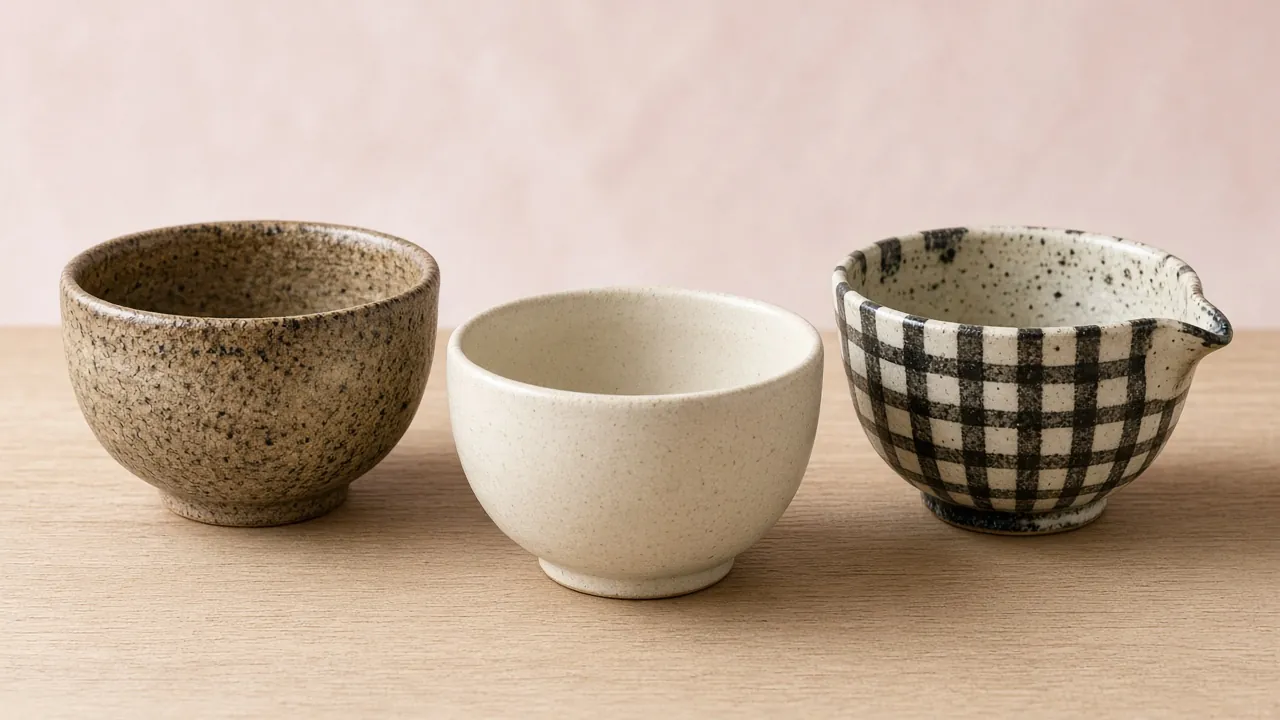
What bowl capacity and shape work best for whisking matcha?
Most foam problems blamed on the whisk or the water are really a bowl problem: too little room, the wrong base, or walls that send liquid over the rim. Here is how to read a bowl by its numbers before you whisk in it.
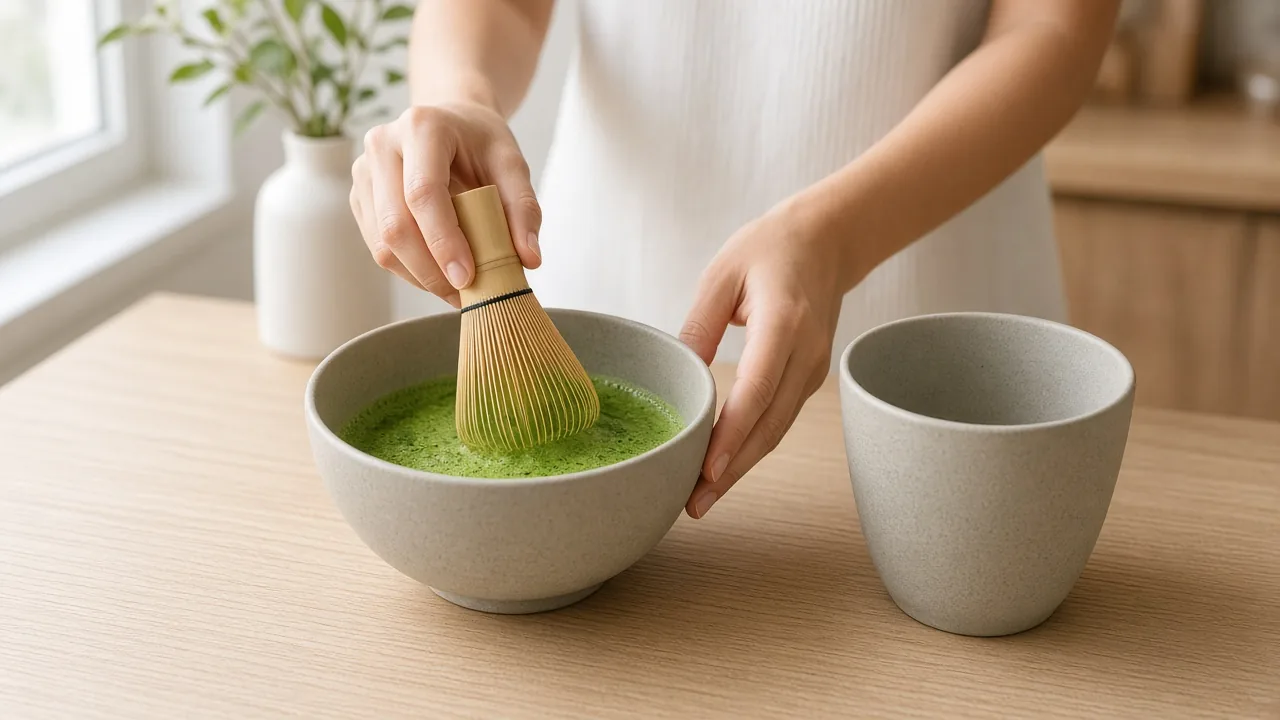
Why the bowl decides the foam
Whisking matcha is a fast back-and-forth movement, roughly in an M or W pattern, that pushes air into a small volume of liquid. To do that, the tines need a long, unobstructed path and a flat surface to brush against. If you are choosing a matcha bowl mainly to whisk in — not just to drink from — capacity and shape matter more than glaze or colour. Our broader guide to the chawan covers materials and style; this article sticks to the geometry.
Capacity: more room than you think
A typical thin matcha uses only 60–80 ml of water, so a 150 ml cup can look big enough. It is not. Foam roughly doubles the volume of the liquid, and the whisk itself displaces space. As a rule of thumb:
- 300–450 ml total capacity is the comfortable range for an everyday bowl. The liquid stays shallow, around 1.5–2 cm deep, which is exactly where a chasen works best.
- Under 250 ml, the liquid is deep and narrow: the whisk churns instead of aerating, and splashes are common.
- Over 500 ml is fine for whisking a double portion or a latte base, but a single serving spreads so thin that it cools quickly.
The measurement to remember is not the capacity on the label but the depth of liquid once you pour your water in. Aim for a shallow layer, not a deep pool.
Inner diameter: the real number to check
The inner diameter at the rim is what gives your wrist room. Around 11–13 cm suits most people and a standard 80- or 100-tine whisk. Narrower than 10 cm and the tines touch both sides on every stroke; wider than 14 cm and a small serving becomes a thin film that is hard to froth. If a product page only gives the outer diameter, subtract about 1 cm for the walls of a ceramic bowl.
The base: flat, not pointed
Look at the inside of the bowl, not the outside foot. You want a flat or gently rounded floor of at least 5–6 cm across. That flat area is where the tines brush and where foam starts. A V-shaped or deeply curved floor funnels the whisk to the centre, so you end up drawing small circles, and the powder at the edges never gets fully mixed.
Wall profile: straight, open or tulip
- Straight, fairly upright walls (the classic "han-tsutsu" profile) hold splashes well and suit energetic whisking.
- Open, flared walls look elegant and cool the drink faster — fine in summer, but liquid can climb and spill if you whisk hard.
- A slightly inward-curving rim (tulip shape) catches splashes and keeps heat in. It is a good choice if you whisk vigorously or make thicker preparations.
Wall height of about 7–8 cm gives a safe margin above the liquid for most styles.
Weight and footing
A bowl that slides while you whisk forces you to hold it tight, which tenses your whole arm. A stoneware bowl of 300–450 g with an unglazed foot ring stays put on a wooden or stone counter. Lighter porcelain works too; simply rest your free hand on the rim.
Match the bowl to how you drink
Daily thin matcha
A 350 ml bowl, 12 cm across, with a flat floor is the all-rounder. You drink straight from it, so a comfortable rim matters as much as the inside.
Lattes and iced drinks
You only whisk a concentrated shot, then pour it over milk. A bowl with a pouring lip saves drips, and a slightly smaller capacity is fine because the bowl is a mixing tool, not a cup.
Thicker preparations
Thicker matcha is kneaded slowly rather than whisked fast. A heavier bowl with higher walls and a smooth, slightly curved floor makes that gentle motion easier.
How the whisk and bowl work together
The bowl and whisk should be sized together. A 100-tine whisk is a little fuller and benefits from the upper end of the diameter range; a compact travel whisk works in smaller bowls. If your foam is coarse even in a well-shaped bowl, the issue is more likely the whisking technique or tired tines — compare options in our matcha whisk collection.
A quick checklist before buying
- Capacity of 300–450 ml for one serving.
- Inner diameter of roughly 11–13 cm.
- A flat interior floor at least 5–6 cm wide.
- Walls about 7–8 cm high, upright or slightly inward-curving.
- Enough weight, or a foot ring, to stay steady.
If a bowl ticks these five boxes, whisking becomes noticeably easier, whatever matcha you use.
Quick answers
Can I whisk matcha in a regular cereal bowl?
Yes, if it is wide (about 12 cm), has a flat floor and walls high enough to stop splashes. Many cereal bowls have a rounded floor that pushes the whisk to the centre, which makes foam less even.
Is a bigger bowl always better?
No. Beyond about 500 ml, a single serving spreads too thin to froth well and cools fast. Bigger bowls make sense for double portions or latte bases.
Does the shape change the temperature?
Yes. Open, flared walls release heat quickly; upright or inward-curving walls keep the drink warm longer. Warming the bowl with hot water first helps whatever the shape.
Léo Matcha sells matcha accessories only — no matcha tea or powder. Use the matcha you already love.