How much matcha to scoop without a scale
Recipes say 1.5 g or 2 g, but few people weigh their matcha at 7 a.m. The good news: a scoop, a consistent gesture and a few visual cues give you a dose that varies by less than you would think. Here is how to get there.
Why the scoop beats a guess
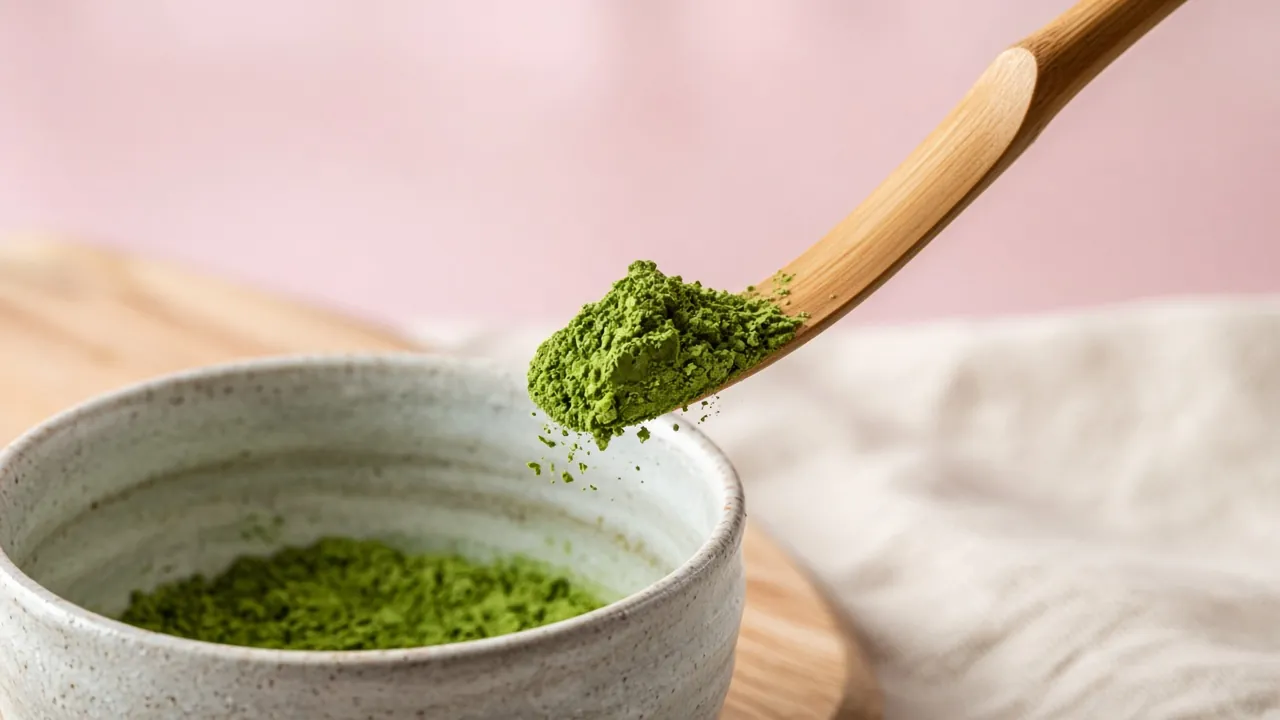
A bamboo scoop has a fixed width and curve, so if you always use it the same way, it delivers roughly the same amount. That is the whole point of a matcha scoop: it turns an approximate pinch into a repeatable unit. For the history and shape of the tool, see our chashaku guide; here we focus only on quantities.
The reference values
These are averages for a standard bamboo chashaku with a fine, sifted-quality powder:
- One level scoop (powder flush with the edges): about 0.5–0.7 g.
- One heaped scoop (a small rounded mound): about 1 g.
- One level metal teaspoon: about 2 g, so roughly two heaped bamboo scoops.
- One heaped metal teaspoon: 3 g or more — easy to overdose.
Powders differ in density. A very fine, fluffy powder weighs less per scoop than a coarser or slightly compacted one. Treat these figures as a starting point, then calibrate.
Calibrate once, dose by eye forever
You do not need a scale every day, but borrowing one once helps. If you have no scale at all, use the teaspoon method below.
With a scale, one time
- Set a small dish on a kitchen scale and zero it.
- Take ten heaped scoops in your usual way and tip them into the dish.
- Divide the weight by ten. That is your personal heaped scoop.
Without any scale: the teaspoon method
- Fill a level metal teaspoon (about 2 g) and tip it onto a dark plate.
- Next to it, place heaped scoops one by one until the little pile looks the same size.
- The number of scoops you needed is your 2 g equivalent — usually two.
Either way, note the result on a card in your tea drawer. After a week, your eye remembers it.
How to scoop consistently
- Always the same gesture. Dip the tip, lift, and let the excess fall back into the tin. Do not press the scoop into the powder: compacting it can double the dose.
- Level or heaped, but decide. Pick one style and stick to it. Mixing the two is the most common cause of a drink that tastes different every morning.
- Same tin, same fill level. Powder at the top of a freshly opened tin is airier than at the bottom of a half-empty one. Stir gently with the scoop before taking your dose.
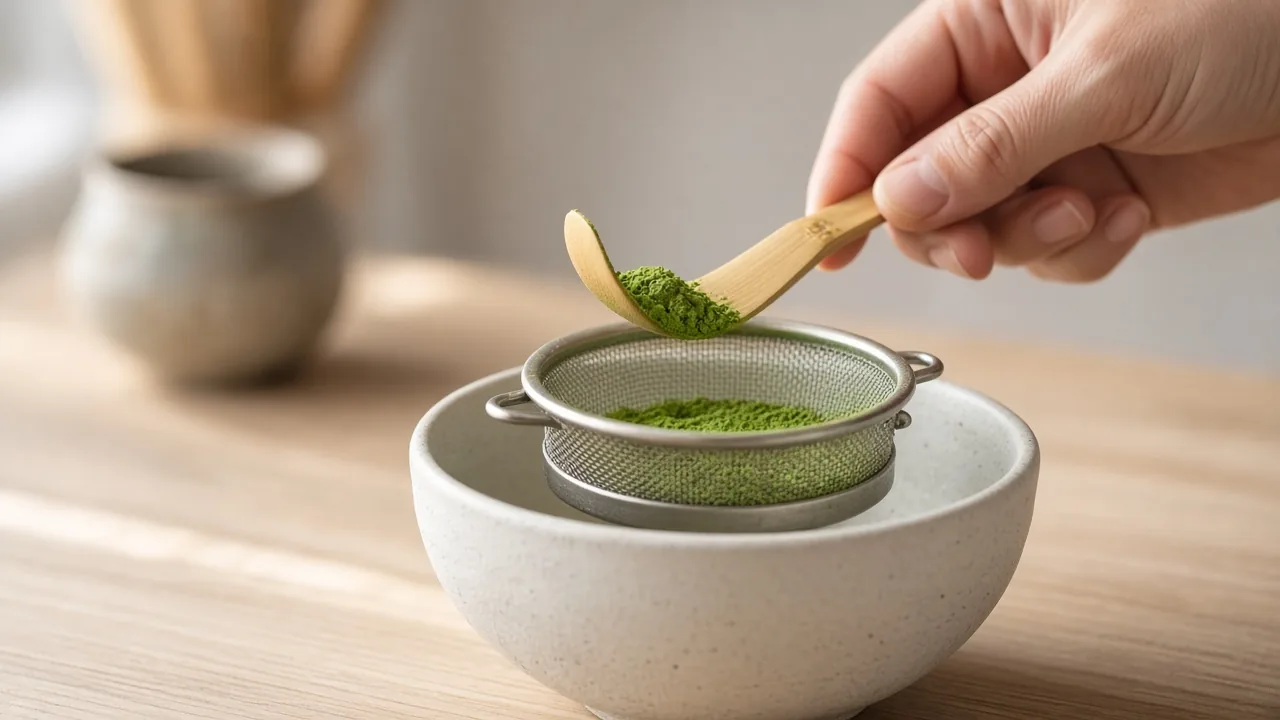
- Scoop into the sifter, not the bowl. It breaks up clumps and makes it easier to see whether your mound looks right.
Visual cues in the sifter
Once the powder is in the sifter, look at its footprint. For a single light serving of about 1.5–2 g, it forms a small mound roughly the size of a one-euro coin and about 1 cm high. If it covers most of the mesh, you have a double dose. If it barely shows, add another scoop.
Doses by drink, in scoops
- Light, frothy bowl (70–80 ml of water): 1½–2 heaped scoops.
- Thick preparation (30–40 ml of water): 3–4 heaped scoops.
- Latte, 250–300 ml total: 2–3 heaped scoops in a small shot of water.
- Large iced drink, 450–500 ml: 3–4 heaped scoops, because ice and milk dilute the taste.
Signs your dose is off
Too much
The drink tastes harsh or very bitter, the foam is thick but sticky, and some powder stays on the sides of the bowl. Drop half a scoop next time.
Too little
The colour is pale, the foam collapses quickly and the drink tastes thin or watery. Add half a scoop.
Clumps rather than dose
Small dark specks or a gritty finish usually mean the powder was not sifted, not that the dose is wrong. Sift first, then judge.
Adjusting for the water, not just the powder
If you change the amount of water, change the dose in proportion. A common mistake is keeping two scoops for a mug of 200 ml: the drink becomes weak, and the reflex is to blame the powder. Keep the ratio around one heaped scoop per 35–40 ml for a light bowl.
A note on travel
In a hotel or at the office, a scoop is lighter than a teaspoon and easier to clean. Pre-measure a few doses into a small jar if you prefer: one scoop per dose at home, the right number in the jar, and you will not need to guess on the road.
The short version
Calibrate your scoop once, always scoop the same way, sift before judging, and adjust in half-scoops. That is enough for a consistent dose without ever weighing again.
Quick answers
How many scoops for one cup of matcha?
For a light bowl with 70–80 ml of water, 1½ to 2 heaped bamboo scoops, which is about 1.5–2 g. Adjust by half a scoop to taste.
Is a teaspoon the same as a matcha scoop?
No. A level metal teaspoon holds about 2 g, roughly two heaped bamboo scoops. A heaped teaspoon can hold 3 g or more, which is easy to overdose.
Should I scoop level or heaped?
Either works, as long as you always do the same. Most recipes count in heaped scoops of about 1 g each.
Léo Matcha sells matcha accessories only — no matcha tea or powder. Use the matcha you already love.