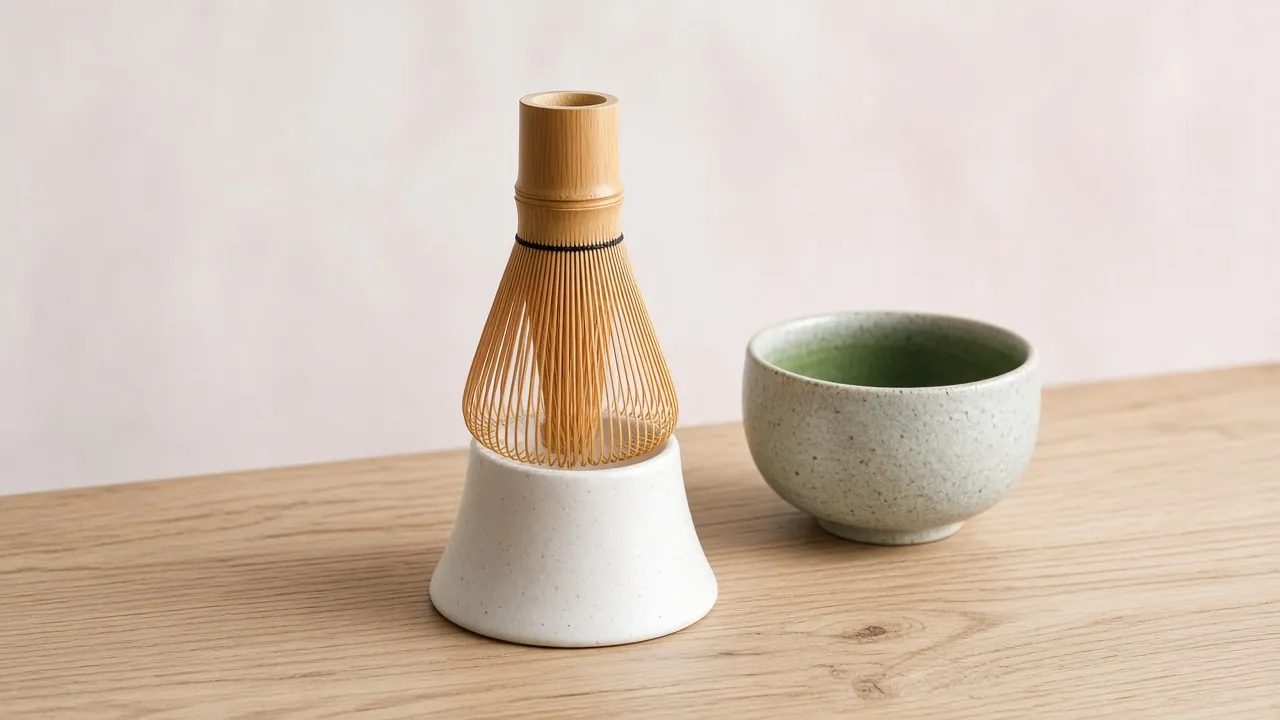
How to dry a bamboo whisk so it keeps its shape
A bamboo whisk rarely dies from use. It dies from the hours after use: a damp whisk left on its side in a closed cupboard slowly loses its curve, closes up and can grow mould. Drying it properly takes thirty seconds and doubles its life.
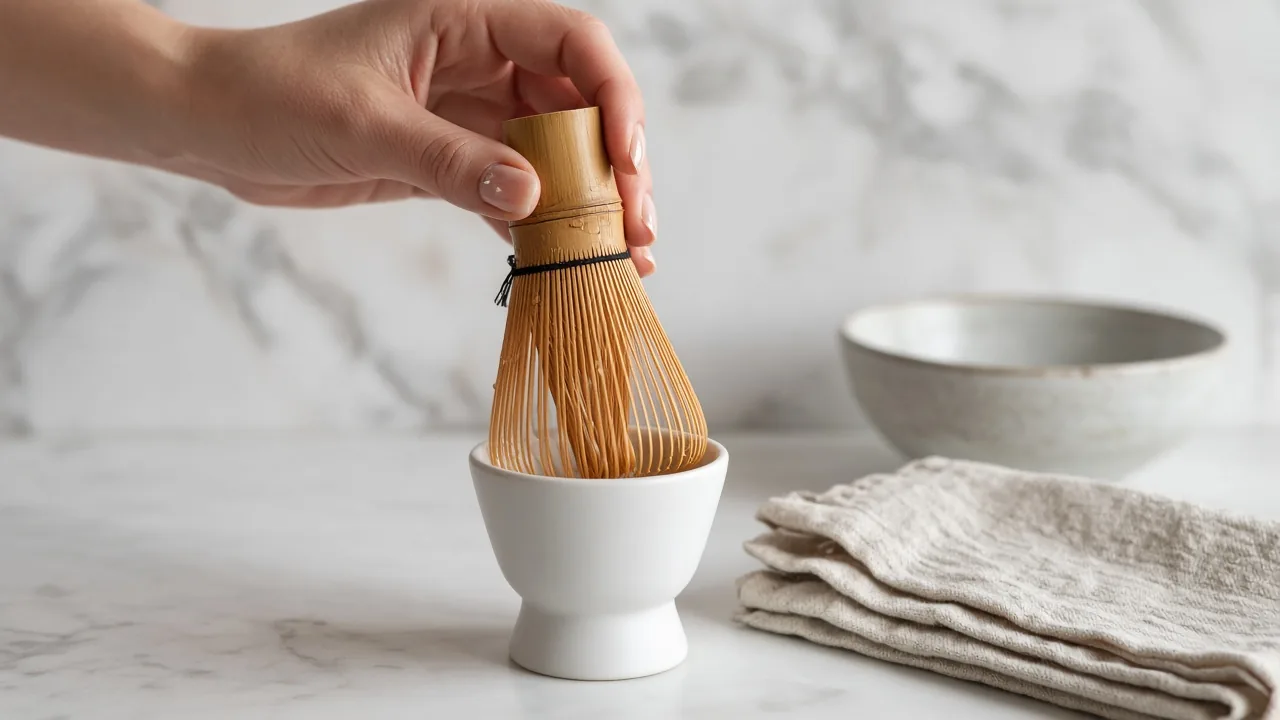
Why drying matters more than washing
Bamboo is a natural fibre. When wet, it softens and takes whatever shape it is held in; as it dries, that shape sets. That is why drying position decides the future shape of your whisk. A good matcha whisk holder is simply a mould that holds the tines in their open bell while the water leaves. We explain the object itself in our guide to the kusenaoshi; this article is about the drying routine.
The 30-second routine after each use
- Rinse in warm water, never soap. Swish the tines in a bowl of warm water until it runs clear. Soap gets trapped in the fibres and taints the next drink.
- Shake gently. Hold the handle, tines down, and give two or three short flicks of the wrist over the sink. Most of the water leaves this way.
- Blot the outside. Wrap a clean cotton or linen towel around the tines and press lightly. Do not twist or rub: the inner tines are thin and break easily.
- Check the inner tines. The small curled tines in the centre trap water. If a few are bent towards the middle, ease them back with a fingertip while they are still supple.
- Place it on the holder. Tines down, centred on the dome, so the inner tines rest around the top of the holder and the outer ones fall naturally.
Where to put it to dry
- In open air, not in a cupboard. A closed space keeps humidity around the bamboo for hours.
- Away from direct heat. A radiator, a sunny windowsill at midday or a hairdryer dries the surface too fast; the bamboo shrinks unevenly and the tines can crack.
- Not next to the kettle or hob. Steam keeps re-wetting the whisk.
- Somewhere with air flow. A shelf or a corner of the counter with space around it is ideal.
In a normal room, a whisk is fully dry in six to twelve hours. In a humid bathroom-adjacent kitchen or in winter with windows closed, it can take a full day.
Upright, upside down or on its side?
- On a holder, tines down: the best option. Water drains away from the handle, the bell keeps its curve and air reaches the inside.
- Standing on its handle, tines up: water runs down into the handle and the base of the tines, which is where mould starts. The tines also tend to splay outwards.
- Lying on its side: the bottom tines flatten and the whisk dries crooked.
- Hanging tines-down without support: better than on its side, but the tines close inwards as they dry.
Signs your drying routine needs adjusting
- The tines are closing up and look like a narrow brush: it dries without support, or it is stored in its original plastic tube while damp.
- The tines splay outwards like an open flower: it dries tines-up, or a holder too wide for the whisk.
- Black or grey spots near the base of the tines: mould from trapped water. Improve air flow, shorten the time before it goes on the holder, and never store it closed while damp.
- Tines cracking at the tips: the bamboo dries too fast or is too dry. Soak the tips in warm water for a minute before each use.
Can you put it away after drying?
Once completely dry — after at least a night — the whisk can go back in a box or drawer if you prefer. Many people simply leave it on the holder: the bell is protected and the whisk is ready for the next use. Avoid the original plastic tube for long-term storage; it holds humidity.
What about a new whisk?
A new whisk often arrives with its tines tightly closed from the packaging. Soak it in warm water for two or three minutes, then dry it on a holder. After two or three cycles, the bell opens to its proper shape.
Electric whisks too?
An electric frother has a metal coil, not bamboo, so the shape is not at risk. Still, rinse the head and let it air-dry before putting it back in its stand. If your electric model takes a bamboo head, dry that head like any chasen. Compare bamboo and electric models in our matcha whisk collection.
The short version
Rinse warm, shake, blot without rubbing, then dry tines-down on a holder in open air. That one habit keeps the shape, avoids mould and keeps your whisk making fine foam for months.
Quick answers
How long does a bamboo whisk take to dry?
Six to twelve hours in a normal room, and up to a day in a humid kitchen. Leave it overnight on a holder before putting it away.
Can I dry my whisk with a hairdryer?
No. Fast heat dries the surface unevenly and can crack the tines. Let it dry at room temperature, in open air.
Is a small amount of mould dangerous?
Mould on bamboo cannot be fully removed from the fibres. If you see black spots that come back after rinsing, replace the whisk and improve the drying routine for the next one.
Léo Matcha sells matcha accessories only — no matcha tea or powder. Use the matcha you already love.